
Indian Institute of Drone Technology
भारतीय ड्रोन प्रौद्योगिकी संस्थान
Indian Institute of Drone Technology
भारतीय ड्रोन प्रौद्योगिकी संस्थान
Indian Institute of Drone Technology
भारतीय ड्रोन प्रौद्योगिकी संस्थान
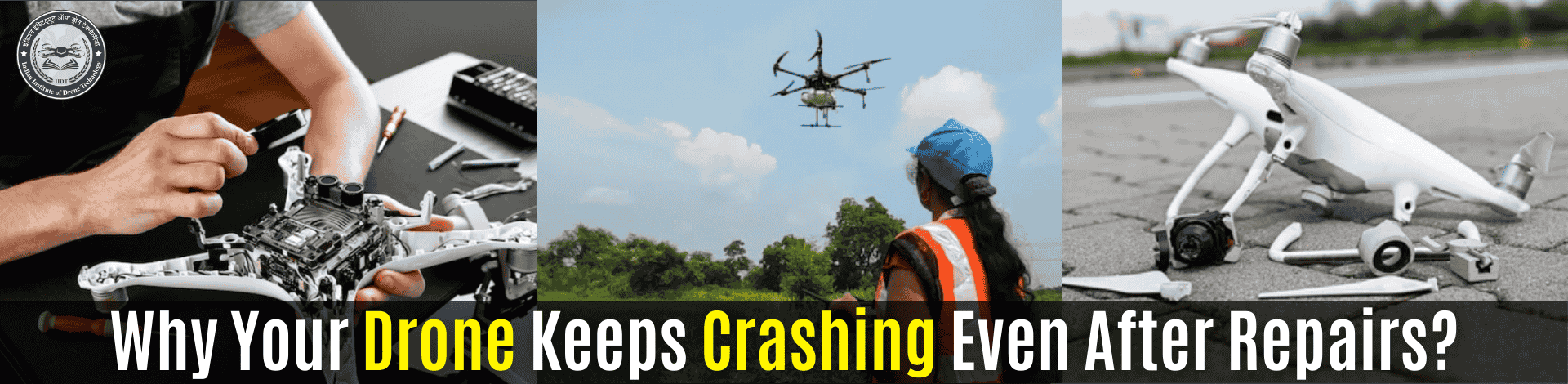
Have you ever repaired your drone, tested it briefly, and still watched it crash again? That frustration is more common than most operators admit.
Repeated crashes usually signal deeper system issues, not bad luck or flying errors. Most recurring drone crashes happen due to calibration, firmware, or integration faults rather than visible hardware damage.
In many cases, technicians trained through Drone Repair Courses in India to understand that repair is not just replacement. It is a system-level diagnosis. This difference separates temporary fixes from long-term flight stability.
Misdiagnosed Root Causes During Drone Repair
Most drones crash again because technicians fix parts, not the underlying system behavior.
Modern drones from DJI and similar manufacturers rely on tightly integrated sensors, firmware, and flight controllers. Replacing a motor without recalibrating the IMU or ESC timing creates instability.
Most workshops assume hardware replacement equals repair. However, 2025 industry behaviour shows configuration errors cause more failures than broken parts.
Stats to know:
- According to 2025 reports, over 62% of post-repair crashes involved incorrect sensor calibration.
- A 2025 trend analysis shows flight-controller mismatch as a top failure cause.
- Experts consider this a turning point in professional drone maintenance.
Expert quote
“Drone repair without diagnostics is like surgery without scans,” says Rajiv Malhotra, UAV systems auditor and DGCA consultant.
Ignoring Security, Interference, and Signal Integrity
Signal interference and security misconfiguration silently cause many post-repair crashes.
As Drone Security Solutions become more common, geofencing conflicts, RF interference, and spoofing risks increase. Many technicians focus only on physical repair, ignoring signal integrity.
Experts consider this a turning point as drones increasingly operate near critical infrastructure and urban zones.
Q. How does signal interference affect repaired drones?
It disrupts GPS lock, command latency, and autonomous decision-making.
Q. What are the benefits of secure configuration?
Stable navigation, safer failsafe triggers, and predictable flight behavior.
Poor Post-Repair Testing and Environmental Simulation
Many drones crash again because they were never tested under real operating conditions.
Professional operators working on infrastructure projects with organizations like Tata test drones under wind load, GPS noise, and payload stress.
Drone crashes often occur during real missions, leading users to search urgently for “Drone Repair Near Me” services that understand operational testing. Bench testing alone is no longer sufficient. Field simulation is now mandatory for safe operations.
Stats to know:
- According to 2025 reports, 58% of repaired drones failed during first live deployment.
- A 2025 trend analysis shows simulation-based testing reduces crashes by 34%.
Skill Gaps in Unstructured Drone Repair learning
Repeated crashes often trace back to untrained or partially trained technicians. Short-term workshops rarely cover diagnostics, systems engineering, or compliance standards taught at institutes like Indian Institute of Drone Technology.
For students choosing Top Drone Courses in India, the real differentiator is hands-on diagnostics, not just basic flying or part replacement.
Many learners underestimate how drone repair course cost correlates with depth, tooling, and real-world exposure. Cheap training often skips failure analysis frameworks.
- A 2025 trend analysis shows certified technicians reduce repeat failures by 41%.
- Experts from global UAV forums estimate diagnostics training cuts downtime by 30%.
Conclusion
Repeated drone crashes after repairs are rarely accidental. They reflect gaps in diagnostics, calibration, testing, and training. True repair blends hardware, software, security, and environmental awareness. Beyond tools and parts, confidence comes from knowing why a drone behaves the way it does. That understanding keeps machines airborne and professionals trusted.
FAQs
Q1. Why does my drone crash after motor replacement?
Because calibration, firmware sync, and load balancing may be incorrect.
Q2. Is software really more important than hardware in repairs?
Yes. Modern drones rely heavily on software-driven flight decisions.
Q3. Can training reduce repeat drone failures?
Structured training significantly lowers post-repair crash rates.
Q4. How do security settings affect repaired drones?
Incorrect security configurations can trigger failsafes or signal loss.
Q5. Are advanced repair courses worth the investment?
Yes. They prevent repeated failures and improve long-term reliability.
Leave a Comment
Your email address will not be published. Required fields are marked *

Comments