
Indian Institute of Drone Technology
भारतीय ड्रोन प्रौद्योगिकी संस्थान
Indian Institute of Drone Technology
भारतीय ड्रोन प्रौद्योगिकी संस्थान
Indian Institute of Drone Technology
भारतीय ड्रोन प्रौद्योगिकी संस्थान
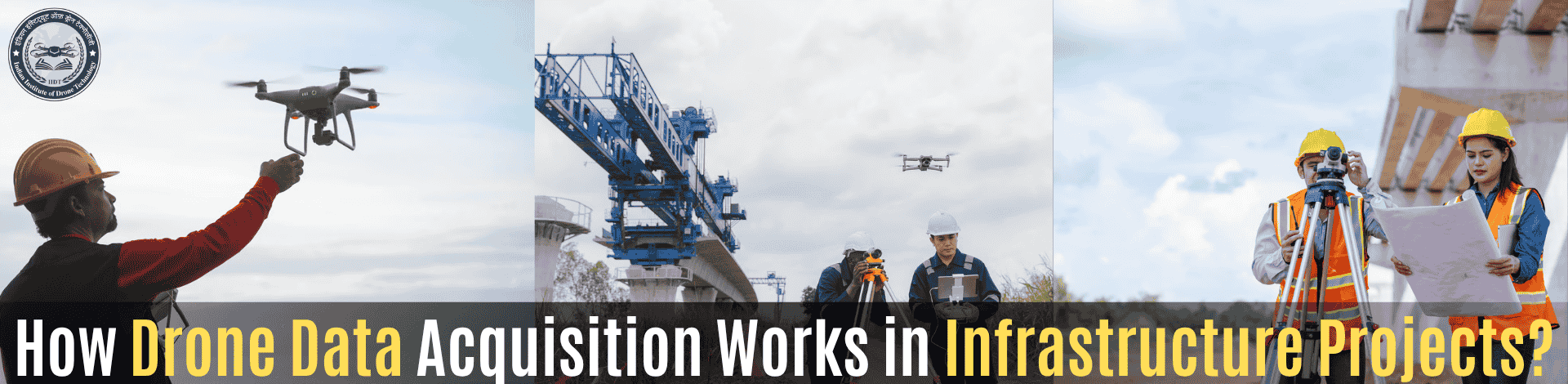
How do modern infrastructure projects achieve centimetre-level accuracy without delaying timelines or increasing costs? The answer lies in Drone Data Acquisition in India, where aerial intelligence now drives faster, safer decision-making across sectors.
From highways to smart cities, drones have replaced slow ground surveys with real-time data capture and analysis.
Drone data acquisition enables infrastructure teams to collect accurate, real-time site data faster and safer than traditional survey methods.
What Is Drone Data Acquisition in Infrastructure Projects?
Drone data acquisition is the process of capturing site data using UAVs for mapping, analysis, and decision-making.
In India, organisations like DGCA regulate drone usage, ensuring compliance and safety in infrastructure operations. Companies increasingly rely on drones for terrain mapping, progress tracking, and risk detection.
Expert Insight
Most companies overlook that drone data is not just visual. It is structured intelligence used for predictive planning in 2026.
- Drones capture data 5-10x faster than manual surveys.
- Accuracy improves up to 2-3 cm with RTK-enabled systems.
- Survey costs are reduced by 30-50%.
- Data processing time drops by 60%.
According to 2026 reports, over 65% of large infrastructure projects in India use drone-based surveys.
Expert Quote
“Drone-based data capture has become the backbone of modern infrastructure monitoring,” states a senior analyst from NITI Aayog.
How Does Drone Data Acquisition Work Step-by-Step?
Step 1. Mission Planning
Teams define objectives using software tools from companies like DJI or GIS platforms.
Step 2. Data Capture
Drones equipped with LiDAR, RGB, or thermal sensors collect aerial data across the site.
Step 3. Data Processing
Platforms powered by NVIDIA GPUs process large datasets into maps and models.
Step 4. Analysis and Output
Engineers interpret outputs such as orthomosaics, 3D models, and volumetric data for project decisions.
- Flight time per survey: 20-40 minutes
- Data processing: 2-6 hours, depending on scale
- Coverage: 100-500 acres per day
- Output accuracy: up to 95% reliability
A 2026 trend analysis shows AI-integrated drones reduce human error in surveys by up to 70 percent.
Expert Quote
“Automation in drone workflows is transforming infrastructure execution timelines,” notes a professor from IIT Delhi.
What Skills and Training Are Required in 2026?
Professionals need technical, analytical, and regulatory skills to handle drone data acquisition effectively. Programs like Advanced Drone Training India, offered by the Indian Institute of Drone Technology (IIDT) focus on real-world applications, not just flying skills.
Expert Insight
In 2026, companies prefer operators who understand data interpretation, not just drone control.
- Training duration: 1-3 months for advanced programs
- Skill demand growth: 30-45% annually
- Core skills: GIS, photogrammetry, compliance
- Industry demand spans construction, mining, and urban planning
The Cost of Drone Maintenance Course in India ranges between ₹15,000 to ₹40,000, depending on specialization.
Expert Quote
“Skill-based drone training is the real differentiator in hiring today,” says a training coordinator at IIDT.
What Does the Future of Drone Data Acquisition Look Like?
Drone data acquisition will become AI-driven, automated, and deeply integrated into infrastructure ecosystems. Institutions like ISRO are exploring satellite-drone data integration for large-scale mapping.
Expert Insight
Most companies overlook that drone data will soon merge with digital twins for real-time infrastructure simulation.
- AI-driven drones are expected to grow by 50% by 2028.
- Integration with BIM and GIS is increasing rapidly.
- Autonomous surveys reducing manual intervention.
- Real-time analytics are becoming standard.
Experts consider this a turning point where infrastructure becomes data-first, not construction-first.
Expert Quote
“Drone intelligence will define the next decade of infrastructure development,” states a senior ISRO research associate.
Conclusion
Drone data acquisition has shifted infrastructure projects from reactive execution to predictive planning. It saves time, reduces cost, and improves safety with measurable impact. As India builds faster and smarter, drones are no longer optional, they are essential. For many learners and professionals, this is more than technology. It is a gateway to shaping the future from the sky.
FAQs
1. What is drone data acquisition in infrastructure?
It is the process of collecting site data using drones for mapping, monitoring, and decision-making.
2. How accurate is drone data acquisition?
Modern systems provide accuracy up to 2-3 cm using RTK and LiDAR technologies.
3. Why is drone data important in infrastructure projects?
It improves safety, reduces cost, and enables faster, data-driven decisions.
4. What skills are needed for drone data acquisition?
Skills include drone operation, GIS mapping, photogrammetry, and data analysis.
5. What is the future of drone data acquisition in India?
It will become AI-driven, automated, and integrated with digital infrastructure systems.
Leave a Comment
Your email address will not be published. Required fields are marked *

Comments