
Indian Institute of Drone Technology
भारतीय ड्रोन प्रौद्योगिकी संस्थान
Indian Institute of Drone Technology
भारतीय ड्रोन प्रौद्योगिकी संस्थान
Indian Institute of Drone Technology
भारतीय ड्रोन प्रौद्योगिकी संस्थान
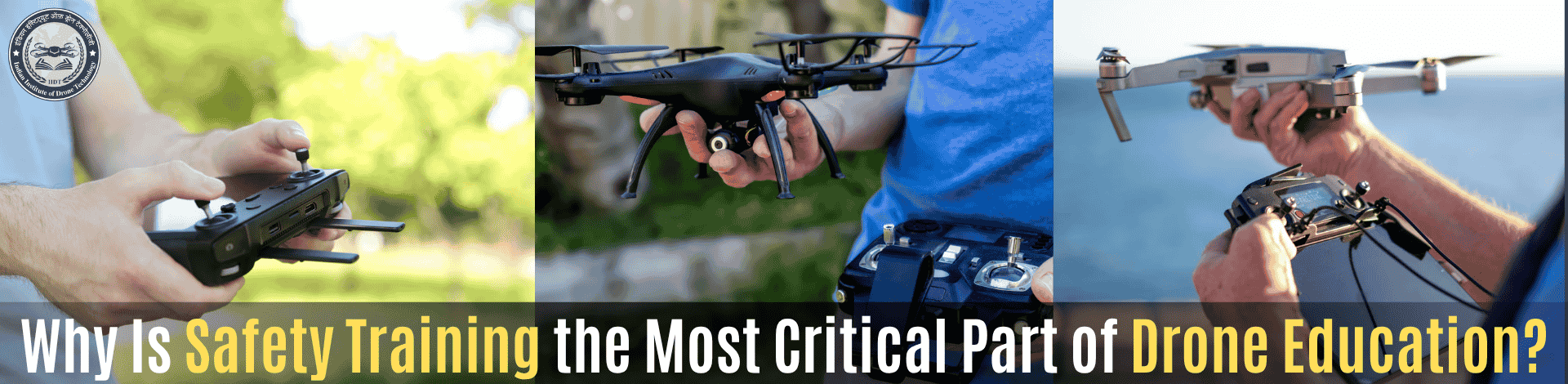
Why do skilled drone pilots still face crashes, penalties, or project failures despite completing training? The answer is simple: Safety gaps, not flying skills, create most operational risks.
In India’s 2026 drone ecosystem, compliance, safety protocols, and real-world readiness define success more than basic flying ability. Choosing the Best Drone Training Institute in India is no longer about certification alone, but about safety-first learning that aligns with real industry conditions.
Safety training determines whether a drone pilot operates professionally or becomes a liability in real-world missions.
Why Safety Training Matters in Drone Education?
Safety training ensures every drone decision reduces risk, not just completes a flight.
Organizations like Directorate General of Civil Aviation (DGCA) have made safety compliance central to drone operations. Without structured safety understanding, even certified pilots struggle in live environments.
A 2026 trend analysis shows that over 65-75% of drone incidents in India are linked to human error, not technical failure. Most companies overlook that pilots often skip pre-flight protocols under time pressure.
- Pre-flight checks reduce failure probability by 40-60%
- Regulatory violations can lead to fines and license suspension
- Urban drone operations carry higher compliance risk zones
- Safety SOP adherence improves project delivery reliability
“In drone operations, safety is not a module, it is the foundation of every mission,” says a senior compliance advisor working with DGCA frameworks.
How Safety Training Works in Real Drone Education?
Safety training combines simulation, compliance learning, and field-based risk management practice.
Leading institutions integrate systems inspired by companies like DJI, where intelligent flight systems are paired with human decision-making protocols.
According to 2026 reports, structured safety programs now include simulator-based crash scenarios, airspace awareness, and emergency recovery drills.
- Simulation training improves reaction time by 30-50%
- Emergency drills reduce crash severity in real missions
- Geo-fencing awareness prevents restricted zone violations
- Weather risk analysis is now part of standard modules
“Pilots trained with real-world simulations show significantly lower incident rates in commercial operations,” notes an instructor from a leading Indian drone academy.
Why Maintenance and Safety Go Hand in Hand?
Drone safety depends heavily on maintenance awareness and system checks. This is where a Drone Maintenance Course in India becomes critical. Institutions like Indian Institute of Drone Technology (IIDT) integrate maintenance training directly with safety protocols.
Experts consider this a turning point because 2026 industry data shows that 30-40% of crashes are caused by avoidable hardware issues.
- Propeller damage is a top 3 cause of drone crashes
- Battery health directly impacts flight stability
- Firmware updates improve safety system accuracy
- Regular inspections extend drone lifespan by 20-30%
“Maintenance knowledge is the difference between controlled flying and unpredictable risk,” explains a drone operations trainer associated with IIDT.
Why Mapping and Survey Projects Demand High Safety Standards?
Drone mapping projects require strict safety discipline due to scale and data accuracy requirements. Programs like a Drone Mapping Course in India teach pilots how to handle large-area missions where small errors can lead to major data loss.
Here’s what the numbers reveal: In infrastructure projects involving entities like ISRO and private contractors, safety lapses can delay projects by 10-15%.
- Mapping missions often cover high-risk terrain zones
- Data errors due to instability can reduce project accuracy
- Flight planning errors increase operational costs
- Multi-drone operations require coordinated safety control
“Precision mapping is impossible without disciplined safety execution at every stage,” says a geospatial analyst working on large-scale infrastructure surveys.
Conclusion
Safety training is not a supporting module. It is the backbone of drone education in 2026. Pilots who understand safety deeply perform better, earn trust faster, and sustain long-term careers. Institutions like the Indian Institute of Drone Technology (IIDT) are already aligning training with real industry expectations. This shift reflects how the market values safety over speed. If you truly want to master drones, remember this simple truth. Flying is easy, but flying responsibly is what makes you a professional.
FAQs
Q. What is drone safety training?
Drone safety training teaches risk management, compliance rules, and emergency handling beyond basic flying skills.
Q. How does safety training work in drone education?
It combines simulations, real flights, maintenance checks, and regulatory understanding for complete operational readiness.
Q. Why is safety training important for drone pilots?
It prevents crashes, ensures legal compliance, and improves mission success rates in real-world projects.
Q. What are the benefits of safety-focused drone education?
Lower risk, higher accuracy, better employability, and long-term career stability in commercial drone operations.
Q. What does the future of drone safety training look like?
It will include AI simulations, predictive analytics, and deeper integration with real industry workflows.
Leave a Comment
Your email address will not be published. Required fields are marked *

Comments