Indian Institute of Drone Technology
भारतीय ड्रोन प्रौद्योगिकी संस्थान
Indian Institute of Drone Technology
भारतीय ड्रोन प्रौद्योगिकी संस्थान
Indian Institute of Drone Technology
भारतीय ड्रोन प्रौद्योगिकी संस्थान
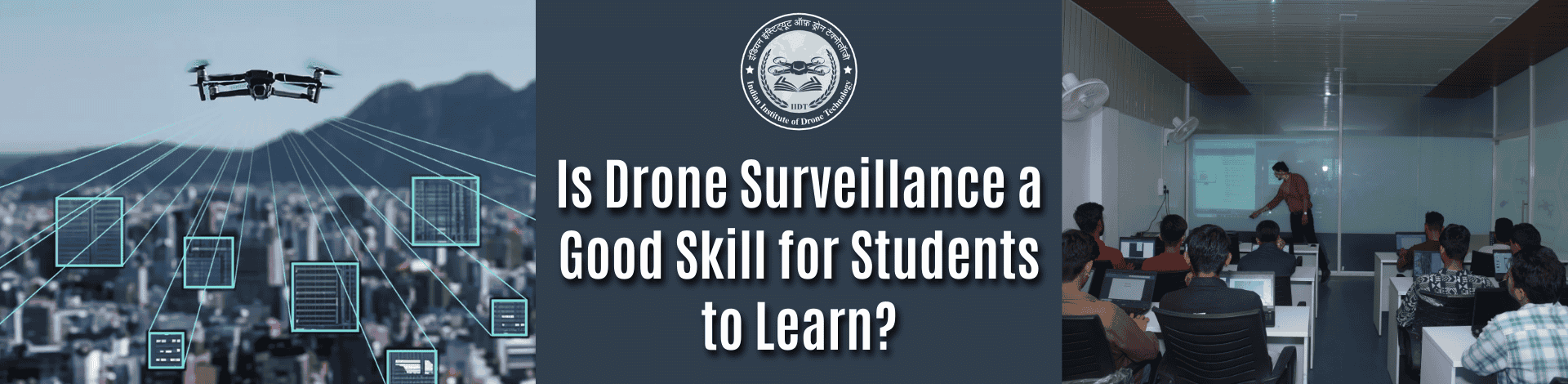
Do you think learning drone surveillance is actually useful for students, or is it just another tech trend?
With AI-driven security, smart cities, and digital infrastructure expanding rapidly, students are increasingly confused about which skills will remain relevant beyond certifications.
In today’s ecosystem, Best Drone Surveillance Systems India are no longer limited to defense or policing. They are becoming part of education, infrastructure monitoring, and enterprise security. This shift makes drone surveillance a skill worth evaluating seriously.
Drone surveillance skills now sit at the intersection of AI, data, and security, making them highly future-proof for students.
Why Drone Surveillance Has Become a Student-Relevant Skill?
Drone surveillance matters to students because it combines technology, analytics, and real-world problem solving.
Organizations like DJI and NVIDIA have transformed drones into intelligent systems capable of real-time monitoring and threat detection. Unlike traditional drone piloting, surveillance focuses on decision-making and interpretation.
Most companies overlook that students trained in surveillance thinking are more valuable than those who only learn flying.
- According to 2025 reports, AI-enabled surveillance drones improve monitoring accuracy by over 40%.
- A 2025 trend analysis shows surveillance-driven drone roles growing faster than recreational drone jobs.
- Experts consider this a turning point in drone education design.
“Surveillance drones are no longer hardware skills. They are intelligence skills.” Industry analyst, India UAV Forum.
What Exactly Is Drone Surveillance?
Drone surveillance is the use of aerial systems to observe, analyze, and secure environments using data.
Unlike hobby drones, surveillance drones integrate cameras, thermal sensors, and analytics software. In India, regulatory oversight is guided by DGCA, ensuring lawful and structured deployment.
Most students assume surveillance means spying. In reality, it is about safety, compliance, and predictive monitoring. This is where drone surveillance techniques such as thermal imaging and pattern recognition become critical learning areas.
How Drone Surveillance Skills Translate Into Careers?
Drone surveillance skills connect students directly to employable roles across sectors.
Enterprises such as Tata Group and Infosys increasingly rely on drone data for infrastructure audits and security planning. This demand has created space for trained analysts, not just pilots.
A 2025 industry survey found that over 60% of drone-related hiring focuses on data interpretation and surveillance logic.
Most companies assume flying skills are enough. However, 2025 industry behavior shows analytical surveillance capability drives higher salaries.
Students pursuing Drone Maintenance Courses in India often complement surveillance skills to become operationally complete professionals.
Why Students Gain an Advantage Over Traditional Tech Paths?
Drone surveillance gives students cross-domain exposure that traditional courses cannot. Surveillance education touches:
- AI
- Cybersecurity
- Geography
- Ethics
It also introduces students to how drone surveillance companies design real deployments, not simulations.
According to 2025 reports, students with applied drone skills demonstrate faster job readiness than purely theoretical tech graduates.
Below are some eye-opening stats to know:
- Surveillance drones reduce human monitoring costs by up to 30%.
- AI-assisted drones cut response time in large facilities by half.
- Experts consider this a turning point in security workforce planning.
“We don’t hire drone pilots. We hire decision-makers trained through surveillance systems.” Security technology lead, India.
What Is the Learning Path for Students?
Students can learn drone surveillance through structured, compliance-aligned programs. Professional training introduces airspace awareness, data ethics, and system integration. Choosing Professional Drone Courses in India that emphasize surveillance use cases is very important. Most companies overlook that early exposure during education builds stronger judgment than post-job training.
Conclusion
Drone surveillance is not just a technical skill. It is a mindset that teaches students how to observe, analyze, and act responsibly. As AI-driven monitoring becomes standard, students equipped with surveillance expertise will stay relevant longer than traditional graduates. Beyond jobs and salaries, this skill builds confidence in handling real-world challenges. Learning drone surveillance today is not about chasing trends. It is about preparing for how technology will actually be used tomorrow.
FAQs
Q1. Is drone surveillance safe for students to learn?
Yes. Training follows DGCA guidelines and focuses on ethical use.
Q2. Do students need engineering backgrounds?
No. Surveillance learning emphasizes logic and analysis, not engineering depth.
Q3. Are drone surveillance jobs in demand?
Yes. Demand is rising across infrastructure, security, and analytics sectors.
Q4. How is surveillance different from drone piloting?
Piloting focuses on flying. Surveillance focuses on data and decisions.
Q5. Can students combine surveillance with other drone skills?
Absolutely. Maintenance and analytics create stronger career profiles.
Leave a Comment
Your email address will not be published. Required fields are marked *

Comments