Indian Institute of Drone Technology
भारतीय ड्रोन प्रौद्योगिकी संस्थान
Indian Institute of Drone Technology
भारतीय ड्रोन प्रौद्योगिकी संस्थान
Indian Institute of Drone Technology
भारतीय ड्रोन प्रौद्योगिकी संस्थान
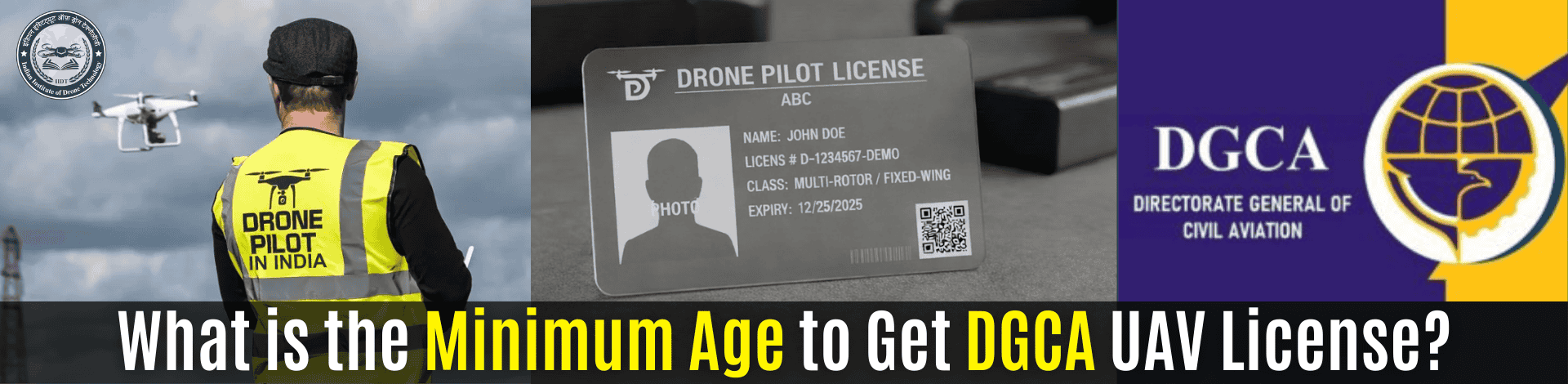
If you want to fly a drone legally in India, the first question is simple: what is the minimum age to get a DGCA UAV license? Many students, working professionals, and drone hobbyists search for this exact answer because new DGCA updates in 2024-2025 have changed eligibility clarity. Parents also ask if their children can start learning early.
Choosing a certified drone pathway matters because a DGCA-approved Remote Pilot Certificate unlocks jobs in agriculture spraying, aerial mapping, surveillance, and industrial inspections.
According to 2025 reports, demand for certified drone pilots will rise significantly across construction, power, mining, and precision farming. UAV Course Certification India programs require learners to meet DGCA standards before they fly in industrial or commercial airspace.
Minimum Age Requirement to Get a DGCA UAV License
DGCA requires a minimum age of 18 years for obtaining a Remote Pilot Certificate for commercial drone operations in India.
This age rule applies across categories like micro, small, and medium RPAS operations under DGCA RPTO institutions regulated by the Ministry of Civil Aviation.
A 2025 trend analysis shows rising inquiries from students below 18 because drone careers are becoming mainstream engineering alternatives. However, DGCA restricts licensing to responsible adults legally allowed to operate autonomous hardware in controlled airspace.
Fact-pack bullets:
- DGCA Unmanned Aircraft Rules implemented in 2021 formalized age requirement standards.
- DGCA drone pilot salary typically ranges between ₹25,000 to ₹1.2 lakh per month based on experience and sector.
“DGCA licensing ensures accountability in national airspace operations,” says Capt. Vishal Menon, an aviation compliance trainer at a Drone Institute in Mumbai.
What Training Looks Like Before Becoming Eligible?
Students below 18 can enroll in drone theory or simulation programs but cannot receive DGCA flight authorization.
Institutions like IIT Kanpur and DGCA-listed RPTOs offer structured simulator courses where younger learners can practice mission planning and Drone Programming in India on closed systems before flying licensed UAVs outdoors. These accredited training pathways help prepare learners for eligibility when they turn 18.
Fact-pack bullets:
- Many RPTOs report 25-35% enrollment interest from under-18 students.
- Analytics from 2024 reports show simulator-based skill development reduces future crash risk by 55%.
- Training modules include flight physics, battery safety, UAV modes, and standard operating procedures.
Reasons Why DGCA Sets the Minimum Age Requirement
The 18-year minimum age helps ensure:
- Safe flight operations
- Regulatory accountability
- Compliance with aviation maturity standards
Most companies overlook that UAV flying requires mission-critical awareness similar to civil aviation. A minor cannot legally sign operational liability documents, insurance coverage, or airspace compliance forms.
Real-world entity example:
Airbus, Boeing, and DJI align global drone rules with ICAO frameworks that permit commercial UAV control only to adults across most jurisdictions. India aligns with these standards to ensure airspace safety.
Age Requirement and Job Market Impact
The 18-year rule aligns India with international aviation compliance frameworks and protects employers from legal liability.
Infosys, TATA Advanced Systems, and several public sector units adopting UAV workflows only hire candidates with valid DGCA licenses for enterprise UAV operations.
DGCA ensures employers minimize insurance and compliance exposure in high-risk industrial environments. UAV certification forms the foundation for advanced careers in AI-enabled surveying and autonomous fleet management.
Future outlook:
- By 2027, drone workforce demand may surpass 75,000 skilled operators nationwide.
- More than 60 industries including mining, logistics, railways, and agriculture will require DGCA-licensed UAV professionals.
Are you searching for the top Drone Technology Institute in India? If the answer is yes, you can begin your journey at the Indian Institute of Drone Technology (IIDT). We have established partnerships with over 100 industry leaders, and here the courses are led by highly experienced trainers.
Conclusion
DGCA requires applicants to be at least 18 to obtain a Remote Pilot Certificate in India. Training early through simulators or ground learning helps students gain skills before reaching eligibility. This rule protects national airspace safety and ensures industries receive responsible certified operators. If you want a drone career, prepare early. When you finally receive your license, you step into a future-ready profession growing faster than most traditional fields.
FAQs
Q1. What is the minimum age for DGCA UAV license?
You must be 18 or older to apply for DGCA Remote Pilot Certificate in India.
Q2. How much does Drone license India cost?
DGCA-linked RPTO training costs typically range ₹30,000-₹90,000 depending on course type.
Q3. Can a 17-year-old train?
Yes, they may study theory, simulation, and ground courses, but certification cannot be issued until age 18.
Q4. Which institutes are eligible?
Only DGCA-approved RPTOs authorized by the Ministry of Civil Aviation can issue valid certifications.
Q5. Do certified pilots get higher salaries?
Yes. Licensed pilots command premium wages in agriculture spraying, mapping, and inspection fields. DGCA drone pilot salary varies based on category and experience.
Leave a Comment
Your email address will not be published. Required fields are marked *

Comments